二元樹 (Binary Tree)
二元樹 (Binary Tree)的重點整理。
前情提要
這篇文章是資料結構系列的第二篇,主要討論 Binary Tree(二元樹) 的基礎概念與相關理論。今天整理了 Binary Tree 的定義、基本性質、常見類型,以及一些重要的數學性質與推導,像是節點數、樹的高度等。此外,也介紹了二元樹的實現方式(陣列與鏈結串列)和走訪方法,並分享了一些經典範例題的解法,希望幫助讀者快速掌握二元樹的核心知識。
Binary Tree 和 Tree 的討論
所有的樹是可以表示成二元樹的 (樹轉二元樹),所以有很多人會把 Tree 跟 Binary Tree 搞混,有很重要的重點就是,樹不可以為空,但是 Binary Tree 可以為空,除此之外樹是沒有順序之分。
-
Tree 和 Binary Tree degree 也有不同,因為 Tree Node’s \(degree >= 0\),但是 Binary Tree Node’s \(0 <= degree <=2\)。
-
像是以下這個圖就是一個例子,在 Binary Tree 中這兩個是不同的樹,但是在樹裡面就是相同的樹。

Binary Tree 定義
- A binary tree is a finite set of nodes that is either empty or consists of a root and two disjoint binary trees called theleft subree an the right subtree. (也就是說二元樹可以是空,那麼由一個 root 和兩個不相交的兩個子樹,這兩個子樹分別為右子樹、左子樹)
Binary Tree ADT
結構 : Binary_Tree (簡寫為 BinTree)
物件 : 一組有限的節點,可以是空的,或包含根節點、左子樹,以及右子樹。
函數定義
以下是最小的操作步驟也就是說你的一個 Binary Tree 需要這些操作才能正常運作,當然你的ADT可ㄧ有很多自定義的操作,但是以 horowitz 的書中是這樣寫的。
-
BinTree Create() : 建立一個空的二元樹
-
Boolean IsEmpty(bt) : if (bt == 空二元樹) 則返回 TRUE,否則返回 FALSE
-
BinTree MakeBT(bt1, item, bt2) : 建立一個二元樹,左子樹為
bt1,右子樹為bt2,根節點包含資料項item -
BinTree Lchild(bt) : if (IsEmpty(bt)) 則返回錯誤,否則返回 bt 的左子樹
-
element Data(bt) : if (IsEmpty(bt)) 則返回錯誤,否則返回 bt 根節點中的資料
-
BinTree Rchild(bt) : if (IsEmpty(bt)) 則返回錯誤,否則返回 bt 的右子樹
Binary Tree Types
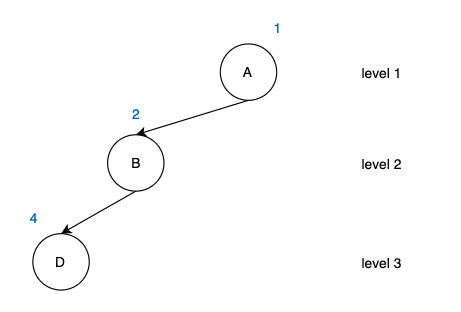
- skewed :
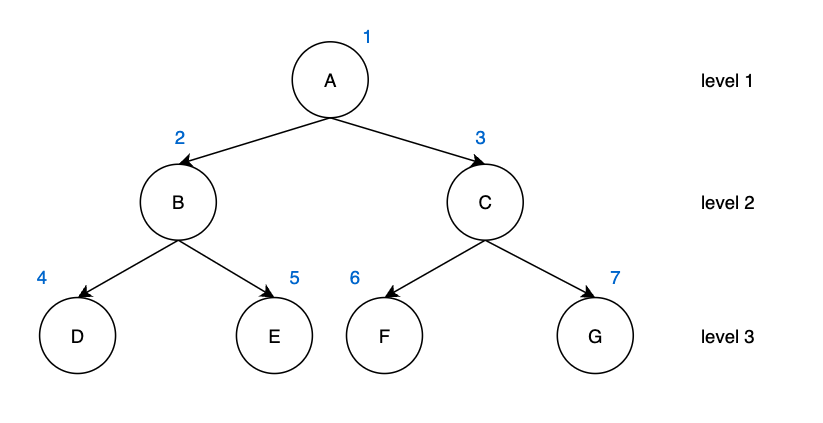
- complete binary tree : 用直白的話說 complete 其實就是你在 n-1 層是滿的且你在第 n 層是一定要按照 binary tree 的順序生成樹的不能有位置跳號的情況。
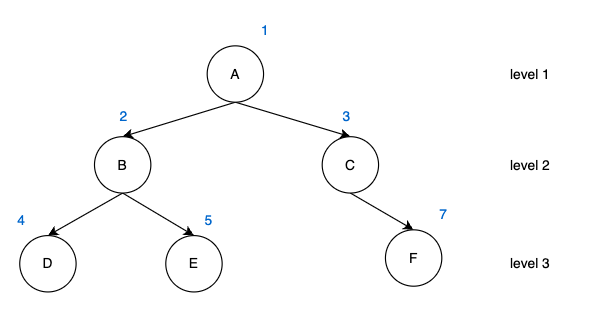
- not complete binary tree :
- full binary tree : 這代表了是把所有編號都長滿那麼這個就是一個 full binary tree,那 full binary tree 也滿足 complete binary tree。

- Strict binary tree : Each non-leaf node will have two children. There is no degree-1 nodes exist.

Binary Tree 的 4 個 Lemma
以下會介紹 Binary Tree 的 4 個 Lemma 其中有兩個屬於 maximum number of nodes 的證明,和一個 Relation between number of leaf node and nodes of degree 2,和一個是從 maximum number of nodes 變化出來的特別針對於 complete binary tree。
Maximum number of nodes
-
The maximum number of nodes on level \(i\) of a binary tree is \(2^{i-1}\), \(i \ge 1\).
- Proof (by induction)
-
Base Case (\(i = 1\))
- 樹中僅有根節點,此時第 1 層節點數為 1。 - 而 $2^{1-1} = 2^0 = 1$,與實際一致。 -
Induction Hypothesis
- 假設對所有 \(j\) 滿足 \(1 \le j < i\),第 \(j\) 層最多有 \(2^{j-1}\) 個節點。
-
Inductive Step
-
由假設可知,第 \(i-1\) 層最多有 \(2^{(i-1)-1} = 2^{i-2}\) 個節點。
-
每個節點最多有 2 個孩子,因此第 \(i\) 層最多有 \(2 \times 2^{i-2} = 2^{i-1}\) 個節點。
-
-
因此,對所有 \(i \ge 1\),第 \(i\) 層節點數的上界皆為 \(2^{i-1}\)
-
- Proof (by induction)
-
The maximum number of nodes in a binary tree of depth k is \(2^k - 1\), \(k \ge 1\).
- Proof :
- 如果有一個 complete binary tree 他有 n 個 nodes 那麼他的深度會是 \(\lfloor log_2n + 1 \rfloor\) 假設一棵完全二元樹有 \(n\) 個節點,則這棵樹的高度可以表示為:
- Proof :
- 以下事項非常重要:
-
節點編號
設 \(i\) 為節點在陣列中的索引,且滿足
\[1 \le i \le n.\] -
父節點
-
- **左子節點**
- **右子節點**
Relation between number of leaf node and nodes of degree 2
在 Binary Tree 有一個現象,leaf 和 degree 2 的點數有些關係,這個證明滿重要的。
\(\forall \, T \, \text{is a nonempty Binary Tree}\), if \(n_0\) is leaf nodes and \(n_2\) is two degree nodes, then \(n_0 = n_2 + 1\).
Proof :
let \(n_1\) is degree one nodes and n the is total number of nodes,那麼我們可以很清楚知道以下公式。
那麼我們又可以知道 \(u=v-1 \Rightarrow n=B+1\), \(B=barnch \, number\) 那麼我們又可以知道以下公式
那麼我們由兩式整理得以下公式
總結
- Lemma 2 可以得知一個 full binary tree 他就會有 \(2^k-1\) 個 nodes,這個應該滿好理解就不說了,在
horowitz書中有寫到第 195 頁底下。
Binary Tree 的最小高度推導
Q1. 若二元樹有 \(n\) 個節點,最小高度是多少?
一棵滿二元樹擁有 \(n\) 個節點時,高度是最小的。滿二元樹是指所有層次都被完全填滿的一棵二元樹。 對於滿二元樹,其節點數 \(n\) 與高度 \(h\) 的關係是:
這可以解釋為,高度為 \(h\) 的滿二元樹,其節點數量是 \(2^h - 1\)。
反過來,最小高度 \(h\) 與節點數 \(n\)的關係為:
因此,如果有 \(n\) 個節點,二元樹的最小高度為:
這公式表明了給定 \(n\) 個節點時的最小高度,對應於每一層節點都儘量填滿的情況。
Q2. 若有 \(n\) 個葉節點,最小高度是多少?
假設我們有 \(n\) 個葉節點,我們要構造一棵高度最小的二元樹。在二元樹中,葉節點的數量決定了樹的最小高度。最小高度的二元樹是一棵滿二元樹,其中所有的葉節點都位於最後一層或倒數第二層。 若我們將 \(l\) 代表葉節點的數量,滿二元樹的葉節點數與高度 \(h\) 的關係為 :
這表示高度 \(h\) 的二元樹最多可以容納 \(2^{h-1}\) 到 \(2^h - 1\) 個葉節點。
對於最小高度,我們取 :
因此,若有 \(n\) 個葉節點,二元樹的最小高度為:
這表示給定 \(n\) 個葉節點,最小高度是 \(\lceil \log_2 n \rceil\) 再加一層 root node。
Binary Tree representations
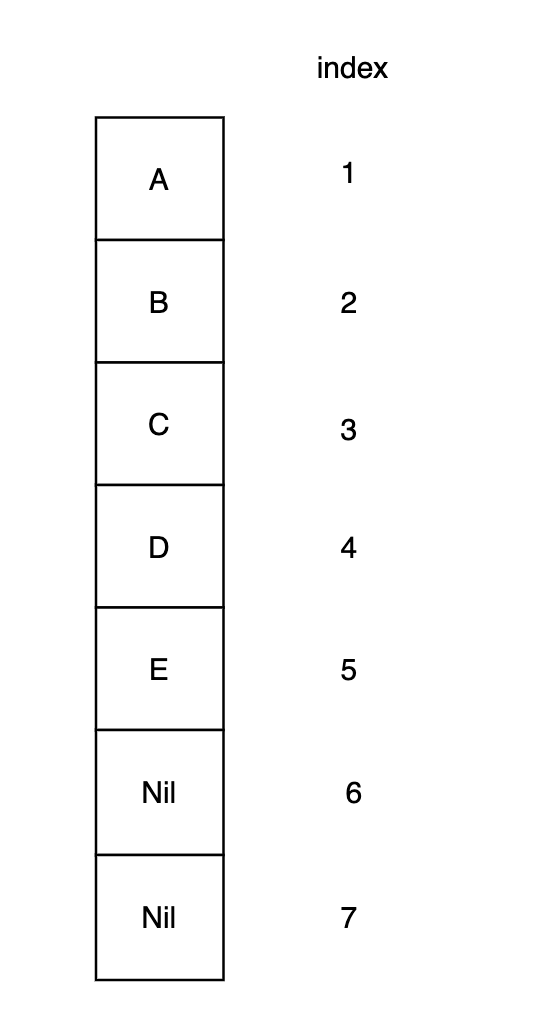
Array method
-
需要 \(2^k -1\) 個 Array 空間。
-
優點
-
容易存取 parent 畢竟 \(\lfloor i/2 \rfloor\) 就可以存取到了。
-
對於 Full Binary tree 可以充分利用,沒有浪費
-
-
缺點
-
不容易刪除解點,但是 dynamic array 可以解決。
-
對於 skewed binary tree 浪費空間如果高度為
H則浪費\(2^{H}-1-H\),可以這樣想畢竟你每個點的數量就 \(1\) 那麼當然就是減高度就可以知道了。
-
-
範例
(A(B,E),C)為例
Link list method
-
優點
-
容易新增和刪除節點
-
對於 skewed binary tree 比 Array 的方式省空間。
-
-
缺點
-
不容易存取父點。
-
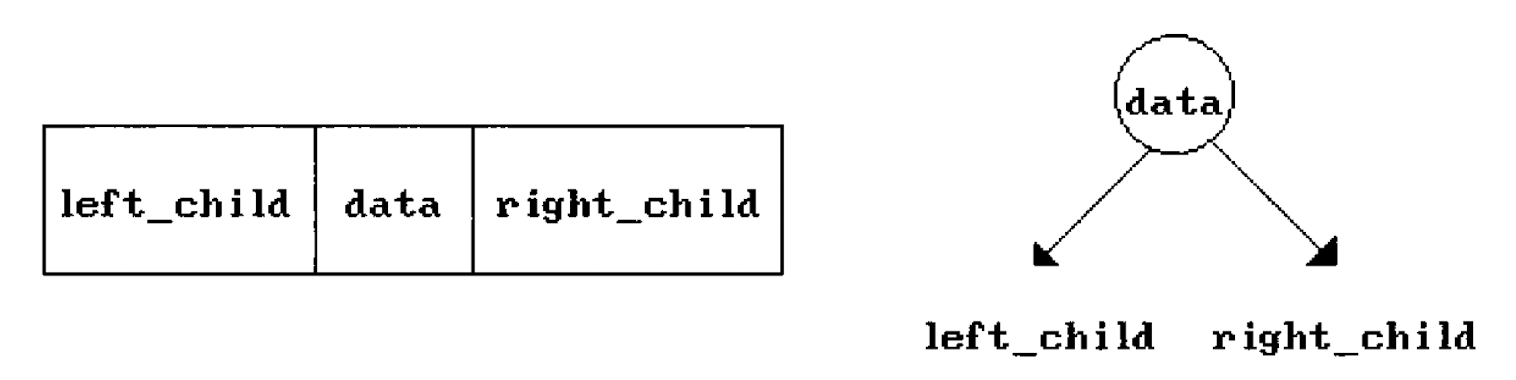
Link space 浪費約一半的空間。如果有 \(N\) 個節點,則有 \(N+1\) 條的 Nil link,由此 \(2N-(N-1)\) 得知。
-
-
範例這邊就不畫了,手快斷掉了哈哈哈:
兩種方式比較
| Array | Link List | |
|---|---|---|
| 優點 | 1. 容易存取左右子點與父點 2. 對於 Full/Complete Binary tree 表示,空間充分利用,無浪費 是 1 的 space |
1. 容易增刪節點 2. 對於 skewed binary tree 比 Array 節省空間 |
| 缺點 | 1. 不容易儲節點點 2. 對於 skewed binary tree 表示,極度浪費空間。若高度 H,浪費格數為 \(2^H - 1\) |
1. 不容易存取父點 2. Links space 浪費約一半。如果有\(N\) 個節點,則有 \(N+1\) 條的 Nil links,有用的 \(2N - (N - 1)\) 條 |
Binary Tree Traversal
大家想想,right subtree 和 left subtree 和 root 有幾種走訪方式 3! 種對吧,但是為了方便,有的就不討論了,核心就是一定要 left subtree 先走,然後才走 right subtre,那麼這樣就分成了,VLR (preorder)、LVR (inorder)、LRV (postorder),反正就看 V 在哪裡就是叫什麼樣的走法,那麼還有一個比較特別的 Level-Order,在 horowitz 書中有寫到那我覺得他就是 BFS 其實,那麼走訪的 complexity 都是 \(O(n)\),畢竟就是看你有幾個點對吧。
-
Determin the Unique Binary Tree,那我總結就是你有 inorder 的走訪路徑,都可以還原成一棵樹,但是有些特例是可以不需要 inorder 就可以還原原本的樹了,complete 包含 full binary tree 這兩種樹都可以不需要 inorder 就可以還原了,當然你給也是可以還原。
-
範例題目 108 中山資管資料結構
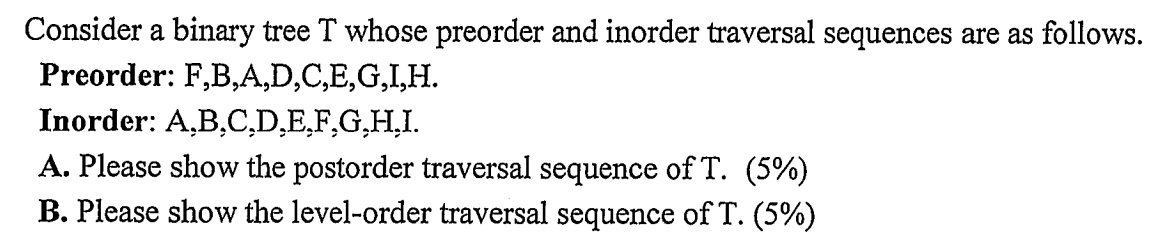
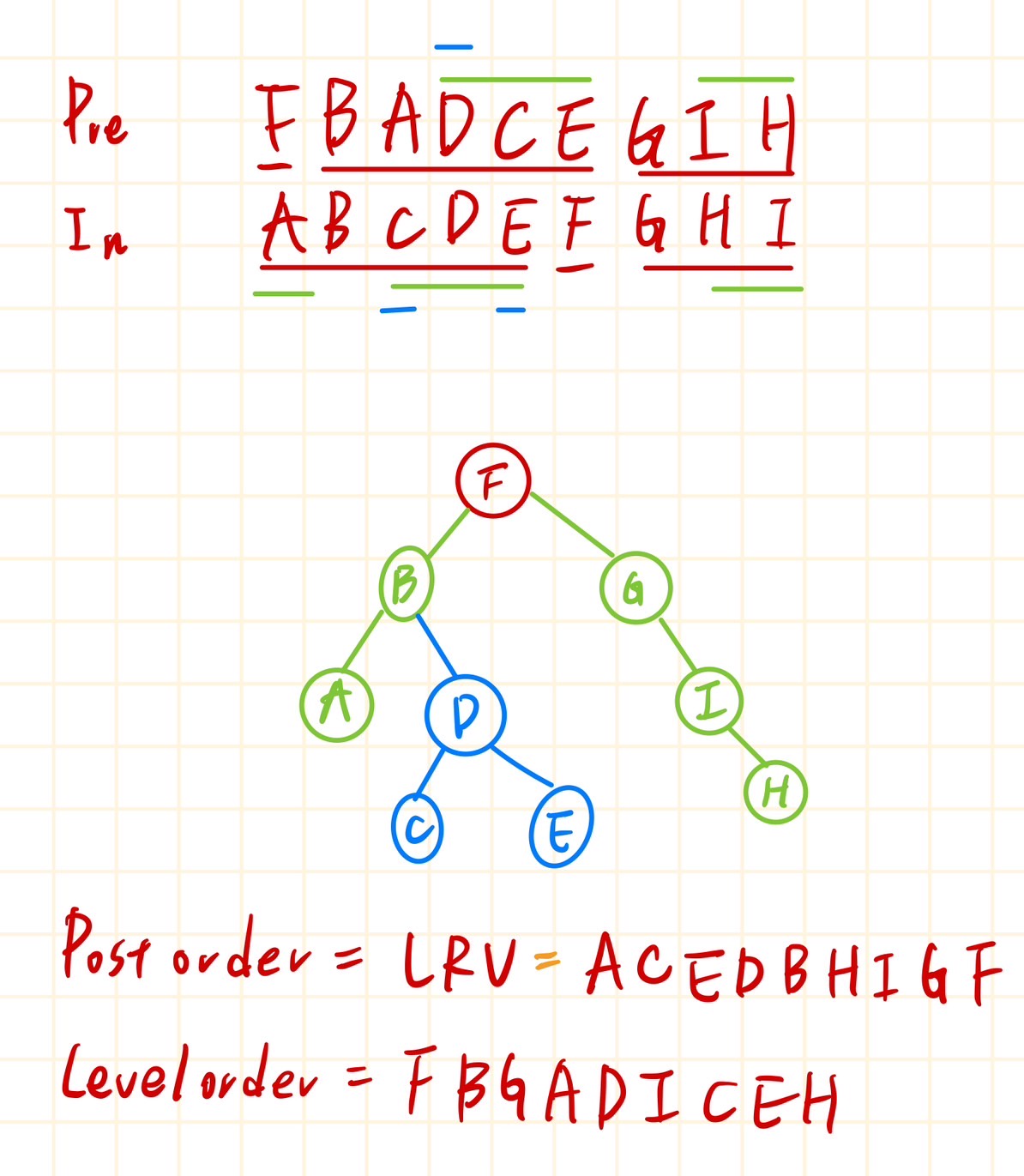
那麼看到這個題目基本就秒殺哈哈哈哈,可以先知道 Preorder 就是第一個是 root 所以去 inorder 從 A 的位置切一刀你就知道左半邊是 left subtree,右半邊是 right subtree,然後一直反覆反覆就可以得知答案了。
Binary Tree Traversal Code
#include <bits/stdc++.h>

using namespace std;

struct Node {
  char val;
  Node* left;
  Node* right;
  Node(char v): val(v), left(nullptr), right(nullptr){}
};

void preorder(Node* root){
  if (!root) return;
  cout << root->val << " ";
  preorder(root->left);
  preorder(root->right);
}

void inorder(Node* root){
  if(!root) return;
  inorder(root->left);
  cout << root->val << " ";
  inorder(root->right);
}

void postorder(Node* root){
  if(!root) return;
  postorder(root->left);
  postorder(root->right);
  cout << root->val << " ";
}

int main() {
    Node* A = new Node('A');
    Node* B = new Node('B');
    Node* C = new Node('C');
    Node* D = new Node('D');
    Node* E = new Node('E');
    Node* F = new Node('F');

    A->left  = B;
    A->right = C;
    B->left  = D;
    B->right = E;
    C->right = F;

    cout << "Preorder:  ";
    preorder(A);
    cout << "\n";

    cout << "Inorder:   ";
    inorder(A);
    cout << "\n";

    cout << "Postorder: ";
    postorder(A);
    cout << "\n";

    delete A; delete B; delete C;
    delete D; delete E; delete F;

    return 0;
}
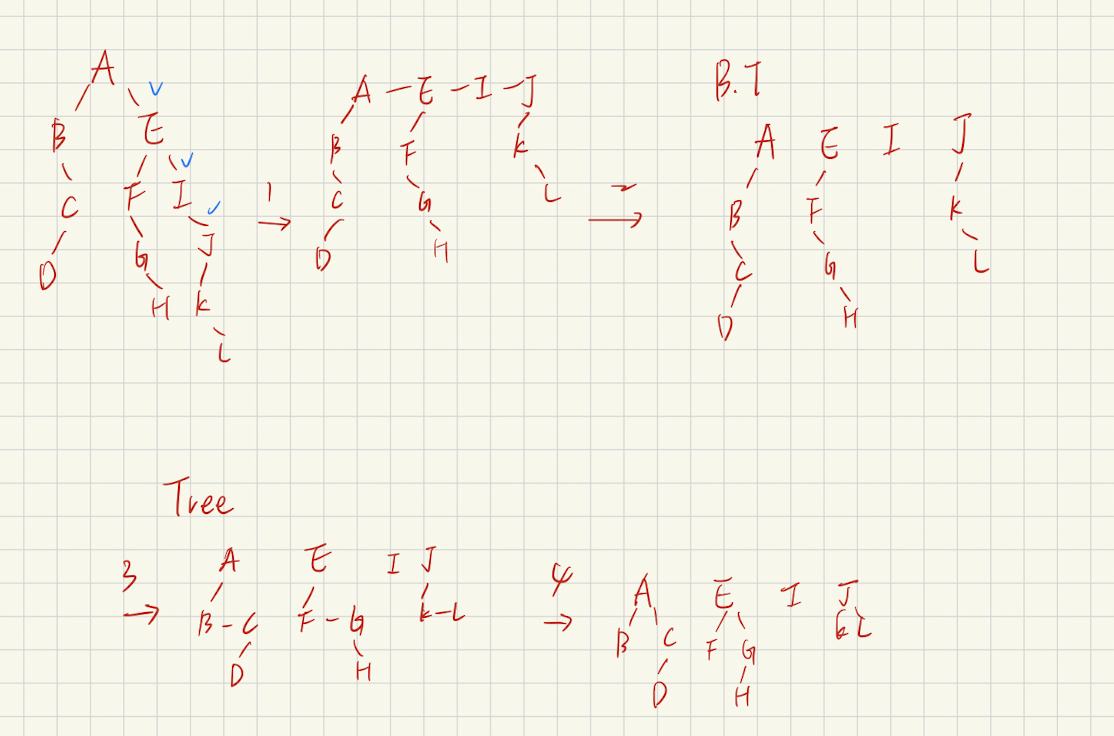
樹(Tree)與二元樹(Binary Tree)的轉換
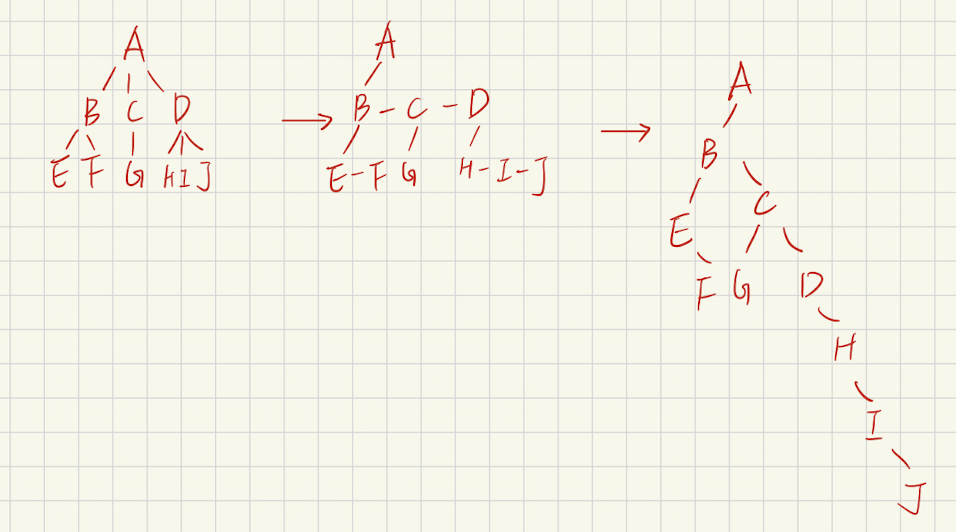
Tree → Binary Tree
-
規則:
- 每個節點的 第一個子節點 成為其 左子節點(left child)。
- 其餘兄弟節點串接成 右子鏈(right sibling)。
- 遞迴處理每個節點。
-
應用: 用於將多叉樹轉換為二元樹,方便儲存與實作。
Binary Tree → Tree
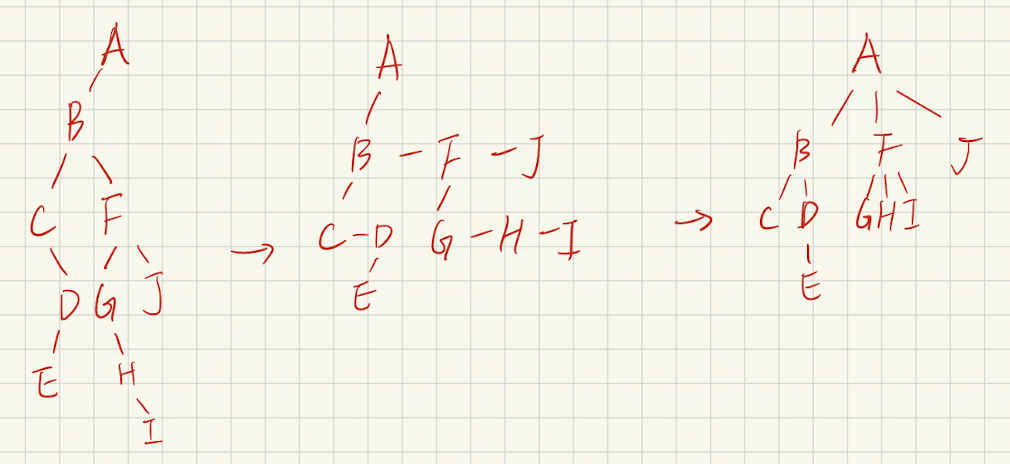
-
規則:
- 將二元樹節點 逆時針旋轉 45°。
- 還原 父子之間的 link。
- 移除只為表示兄弟關係的 右鏈(sibling link)。
-
效果: 還原為原始的多叉樹結構。
森林(Forest)與二元樹(Binary Tree)的轉換
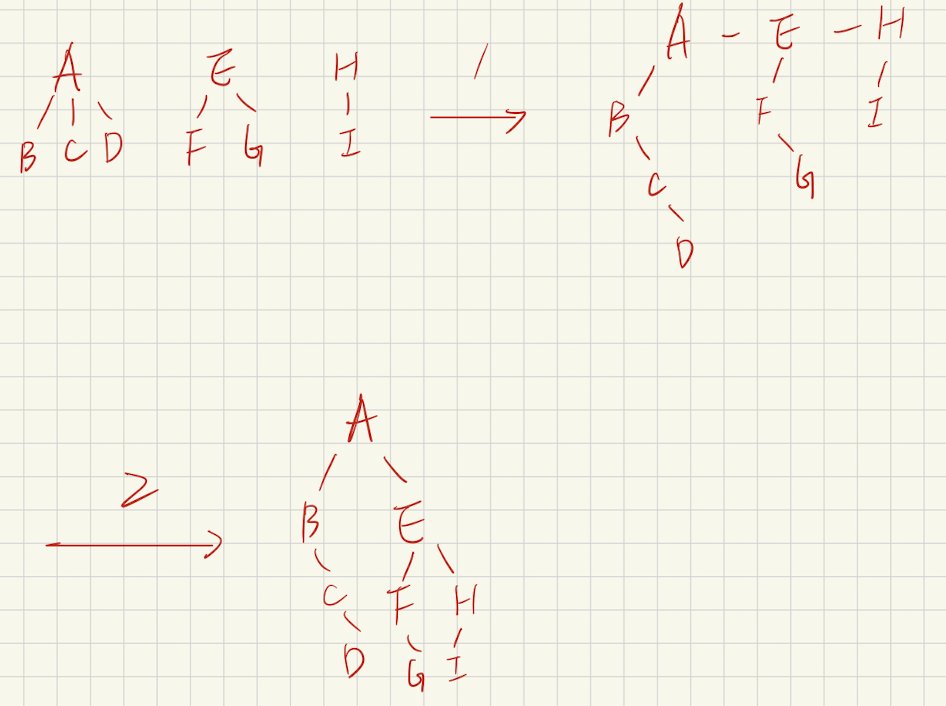
Forest → Binary Tree
-
規則:
- 將多棵樹的根節點視為兄弟,以 右子鏈 串接。
- 每棵樹使用 Tree → Binary Tree 的方式轉換。
- 合併所有轉換後的樹,形成一棵二元樹。
-
時間複雜度: \(O(n)\),其中 \(n\) 為節點數。
Binary Tree → Forest
-
規則:
- 根節點間的 右子鏈 對應到森林中多棵樹。
- 將每棵子樹使用 Binary Tree → Tree 的方式轉換。
- 每一棵還原後的樹構成森林。
-
效果: 還原為森林(多棵無序的多叉樹)。